
MindShifting Reference Guides:
Curiosity Toolkit Series
FREE MINDSHIFTING REFERENCE UIDES FOR EASY REFERENCE AND USE
What If Every Difficult Conversation Could End. With More Understanding - Not Less?
Four free reference guides. One transformative idea.
The skills to change how you handle conflict — everywhere it shows up.
Let's Start Here...
The Problem Isn't That You Don't Care
Conflict is uncomfortable, and most of us were never taught how to navigate it well.
We were taught to win arguments, avoid awkward topics, or simply keep the peace — even when keeping the peace meant quietly seething, pulling back, or watching a relationship slowly erode.
We lead with our position instead of our curiosity. We assume we know what the other person wants, and we argue against the version of them in our head rather than the real person in front of us.
What if there were a better way — one rooted not in tactics or scripts, but in a genuine shift in how you show up?
That's what the Curiosity Toolkit Series is built on.
The MindShifting Method
A Different Way to Engage
MindShifting works upstream. It changes the inner stance you bring to a difficult conversation before a word is spoken — and that shift ripples outward into everything that follows.
STAGE 1
CURIOSITY
Begin with a genuine question: what is really going on for this person?
STAGE 2
UNDERSTANDING
Build a real map of their reality — what they want, fear, and believe is at stake.
STAGE 3
SHARED VALUES
Find the common ground beneath the disagreement and build from it.
STAGE 4
SOLUTIONS
Collaborative paths forward that emerge naturally once the first three stages are in place.
Every guide in the Conflict Toolkit Series is built around this progression. The scenarios change. The relationships change. But the path remains the same.
The Series
Four Guides. Every Context Where Conflicts Finds You
The same person navigating a tense work conversation on Monday is struggling at home on Tuesday and dealing with a difficult customer on Wednesday. These aren't separate problems — they're the same problem wearing different clothes, and they respond to the same solution.
WORKPLACE CONFLICTS
Navigate tension with colleagues, managers, and teams — without damaging what matters.
FAMILY CONFLICTS
Bring MindShifting home — to the relationships that are both the most important and the hardest.
FRIENDSHIP CONFLICTS
Repair, protect, and deepen the friendships you value most — even when it's gotten complicated.
CUSTOMER SERVICE CONFLICTS
Transform frustrating service interactions into moments of genuine connection and resolution.
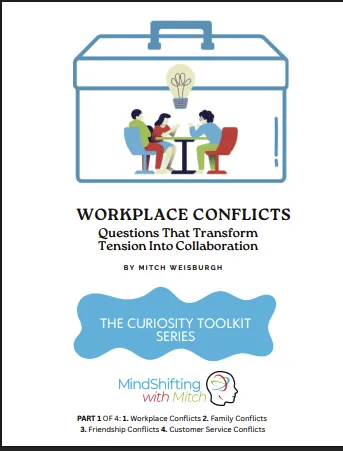
1. WORKPLACE CONFLICTS
Resolve tension with colleagues, managers, and teams - without damaging relationships or your own credibility.
THE CHALLENGE
Work is where conflict is most costly. Unresolved tension reshapes how you show up every day.
Most tools suppress the conflict — and create larger problems over time.
This guide gives you a practical MindShifting approach that leaves the relationship stronger than before.
WHAT'S INSIDE
The three most common workplace conflict patterns
How to approach tension without triggering defensiveness
Scripts for navigating disagreement with a manager
A framework for team conflict without becoming the villain
The mindset shift that transforms your perceived credibility
Imagine walking into your most difficult work relationship today — and walking out with something better: a clearer understanding of where each of you stands, and a path forward that didn't require either of you to 'win.
2. FAMILY CONFLICTS
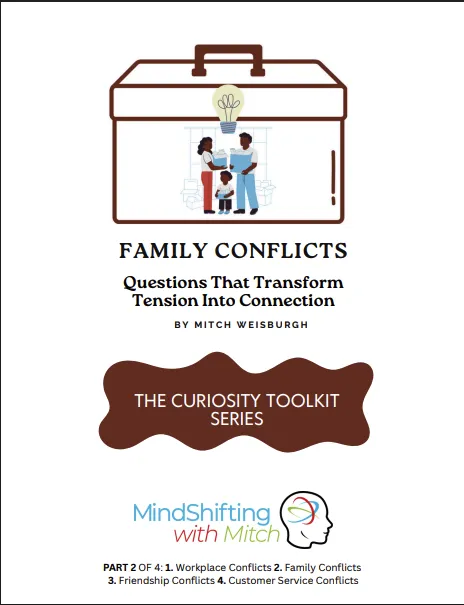
The relationships that matter most are often the hardest to navigate. This guide changes that.
THE CHALLENGE
Family conflict operates on a different level. The stakes feel higher. The history runs deeper.
You can be calm and effective at work — and then watch all of that evaporate at a family dinner in thirty seconds.
This guide covers household responsibilities, teenagers, aging parents, extended family, and money.
WHAT'S INSIDE
How to stay grounded when old patterns activate
Resolving recurring conflicts without reopening old wounds
How to talk to a teenager without triggering shutdown
Aging parent conversations with dignity and directness
Extended family boundary-setting that preserves warmth
The money conversation guide
Imagine approaching your most charged family relationship not with dread, but with confidence — knowing you have a framework that works even when emotions are running high and history is present in the room.
3. FRIENDSHIP CONFLICTS
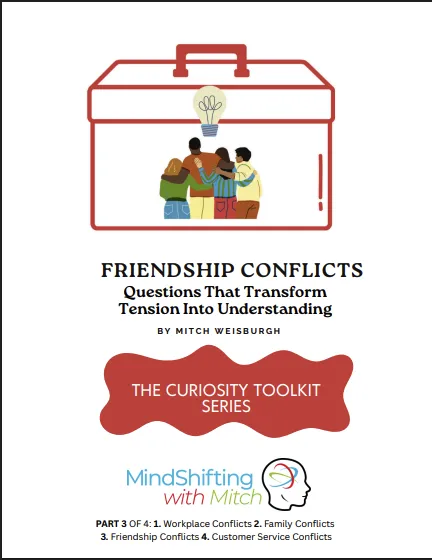
The friendships worth keeping are worth learning how to navigate — even in the difficult moments.
THE CHALLENGE
Most friendship conflicts don't end dramatically.
They end quietly.
A text goes unreturned.
An invitation stops coming.
Two people who once knew each other well slowly drift into mutual avoidance — not because either is malicious, but because the tools for repairing adult friendship are rarely taught or modeled.
WHAT'S INSIDE
What to do when a friend cancels repeatedly
How to address hurt feelings without martyrdom or aggression
Setting boundaries while preserving warmth
How to repair when you were the one who caused the hurt
Navigating the grief of a drifting friendship
Recognizing when a friendship has genuinely run its course
Imagine looking at your most complicated friendship — the one where things are unsaid and questions are unasked — and feeling equipped to walk toward it. Not to fix it by force, but to create the conditions in which it can repair itself.
4. CUSTOMER SERVICE CONFLICTS
From frustration to resolution — for everyone in the exchange.
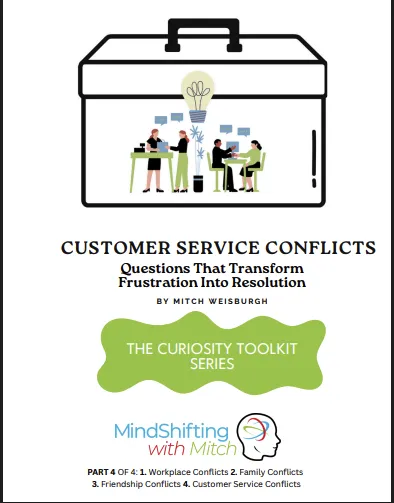
THE CHALLENGE
This is the only guide in the series designed for BOTH sides of the exchange — the frustrated customer AND the service professional.
Every customer service conflict is an interaction between two people: one who feels let down, and one with limited control over the situation they've inherited.
WHAT'S INSIDE
How to escalate effectively without burning the relationship
The phrase that turns a defensive rep into your advocate
For service pros: de-escalating an angry customer
Scripts for billing disputes, shipping issues, policy pushback
How to get to the right person — and stay on their side
Imagine approaching a service call that would usually spike your anxiety — with the calm confidence that you know exactly how to navigate it. That regardless of how the other person shows up, you have a framework that works.
Who Is This For?
This Series Is For You If...
You don't have to be in the middle of a conflict to benefit from these guides. The people who get the most out of the Conflict Toolkit Series are the ones who want to show up better in relationships before things go sideways — and know exactly what to do when they do.
You're a professional who wants to navigate workplace tension without sacrificing relationships or reputation
You're a parent or partner who knows family relationships matter more than winning any argument
You have a friendship that's drifted or fractured and you're not sure how to address it
You regularly deal with customers or service providers and want every exchange to go better
You've learned the frameworks — but conflict still feels hard in the moment
You're already doing the inner work and want language that matches your level of self-awareness
You believe most human conflict is resolvable, and you want the tools to actually resolve it
You want to raise children who navigate conflict constructively — and know that starts with you
Start with the guide that speaks to your most pressing context — and know that the skills transfer.