FREE DOWNLOAD · THE CURIOSITY TOOLKIT SERIES
The Next Tense Conversation at Work
Doesn't Have to Go the Way the Last One Did.
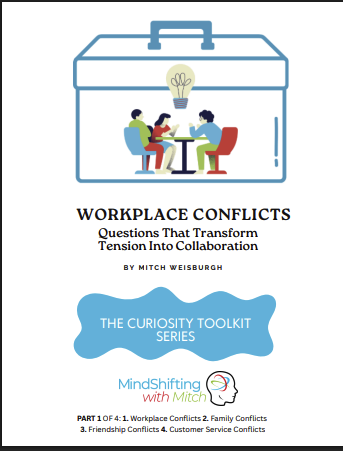
What If One Question Could Change the Outcome of Your Next Difficult Conversation?
Part 1 of the Curiosity Toolkit Series:
Scenario-specific questions for the moments that make or break professional relationships.
When someone disagrees with you at work, your natural instinct is to explain why you're right.
But people can't hear logic when they feel judged.
This guide gives you a ready-to-use set of curiosity-based questions for the workplace's most common flashpoints:
When someone misses a deadline or underperforms
When you disagree with a management decision
When a colleague blames or criticizes you
When two team members are in conflict
SOUND FAMILIAR?
You explain. They don't hear you: You make your case clearly. You're logical, reasonable — and the other person still pushes back. The frustration builds, because nothing you say seems to land.
The conversation escalates instead of resolving: What started as a professional disagreement becomes personal. Defences go up, and suddenly you're managing a relationship problem, not solving the original issue.
You walk away not knowing what to say differently: You replay the conversation afterward, knowing it went badly — but without a clear sense of what the alternative would have looked like.
There's a reason this keeps happening. And there's a specific, learnable shift that changes it — every time.
WHAT YOU'LL GET
Workplace Conflicts is a practical guide — not a theory, not a framework to memorise. It gives you specific questions for the situations you're most likely to face, organized so you can find the right one fast.
Get the Conflict Style Conversation Circle Packet
(Fill this out to access the full session guide and participant materials instantly.)
By submitting this form, you agree to receive occasional emails from MindShifting with Mitch related to education, mindset, and professional development.
You can unsubscribe at any time by clicking the link in our emails and your information will never be shared or sold.
Each question is built on a single insight: when someone feels judged or attacked, their brain goes into survival mode. They cannot hear you — no matter how right you are. These questions change that.
When Someone Misses a Deadline or Underperforms:
Questions that assume good intent and invite problem-solving instead of triggering defensiveness.
When You Disagree With a Decision:
Questions that show respect for the decision-maker while creating space for your perspective to actually be heard.
When a Colleague Blames or Criticizes You:
Questions that de-escalate the moment without backing down or getting drawn in.
THE PATTERN TO REMEMBER:
CURIOSITY -> UNDERSTANDING -> SHARED GOALS -> SOLUTIONS