FREE DOWNLOAD · QUICK REFERENCE GUIDE
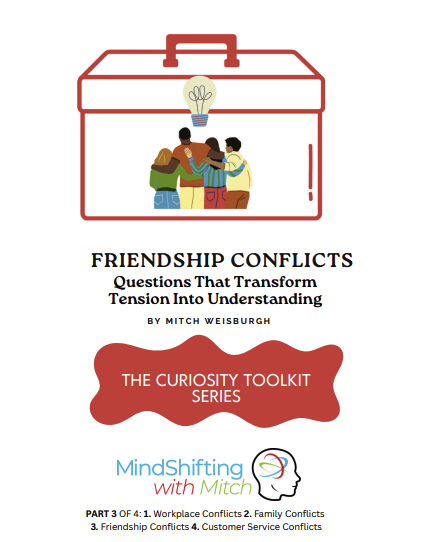
Friendship Conflicts:
Questions That Transform Tension Into Understanding
Friendships are voluntary. Which makes conflict feel riskier — and silence feel easier. This free toolkit gives you questions for the moments when saying something is the bravest thing you can do for a friendship worth keeping.
The toolkit covers five scenarios: when a friend keeps cancelling, when you need to address hurt feelings, when you’re setting a boundary, when you’ve hurt someone you care about, and when a friendship seems to be drifting apart
Most friendship conflicts don’t start with a fight. They start with a silence. Someone cancels again. A comment lands wrong. You feel like you’re always the one reaching out. And you don’t say anything — because what if bringing it up makes things worse?
The secret Mitch has found in years of working with conflict: most friendship tensions come from unspoken expectations.
You expected them to show up. They expected you to understand. Neither of you said what you needed. These questions help you surface that gently, before the silence becomes distance.
Five scenarios. Questions For Each
When a friend keeps canceling: Questions that express you miss them — without guilt-tripping — and open the door for honest conversation about what’s really going on.
When you need to address hurt feelings: How to share what happened for you without blaming, and invite their perspective without putting them on the defensive.
When you’re setting a boundary: Questions that frame boundary-setting as collaboration, not rejection. You can care about someone and still need something different.
When you’ve hurt a friend: How to take responsibility and repair trust. (Reminder included: ‘I’m sorry you feel that way’ isn’t an apology. It’s a dismissal.)
When a friendship is drifting: Questions to understand whether this is temporary distance or a natural ending — and how to have that conversation honestly.
Get your Friendship Conflicts Toolkit:
(Fill this out to access the full toolkit instantly.)
By submitting this form, you agree to receive the asset you have selected and future emails from MindShifting with Mitch to help you master the elements of MindShifting: Resourcefulness, Resilience and Collaboration. It's a consistent way to keep the MindShifting mindset top-of-mind, ensuring you're always prepared to lead with empathy and clarity. Unsubscribe at any time.
The pattern to remember: Curiosity → Understanding → Honesty → Repair