FREE DOWNLOAD · QUICK REFERENCE GUIDE
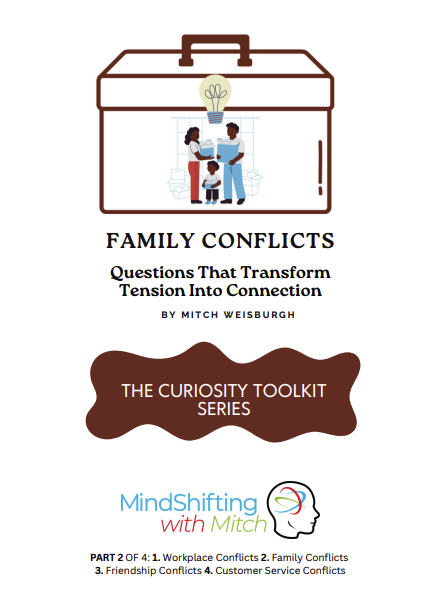
Family Conflicts:
Questions That Transform Tension Into Connection
The hardest conversations are often with the people we love most. This free toolkit gives you specific questions for five common family scenarios so you can replace defensiveness with curiosity and arguments with genuine connection.
The five scenarios are: 1) navigating household responsibilities with a partner, 2) talking with teenagers about their choices, 3) conversations about care with aging parents, 4) setting boundaries with extended family, and the perennial flashpoint of money.
Family conflicts feel different because they are different. You can’t just walk away. The history is longer. The love is deeper. And that means the hurt can go deeper too.
When someone in your family feels judged or attacked, their brain goes into survival mode — they literally can’t hear you, no matter how right you are. These questions help everyone shift from defensiveness to problem-solving.
The secret: most family conflicts aren’t really about the dishes, the screen time, or the money. They’re about deeper needs — to be heard, respected, and valued. When you address those first, the surface problem often becomes much easier to solve..
Five scenarios. Questions For Each
With your partner about household responsibilities: Questions that shift the conversation from ‘whose fault is this?’ to ‘what would feel fair to both of us?’
With teenagers about behavior and choices: Questions that treat teenagers as capable of thinking through their own decisions — because lecturing invites defensiveness every time.
With aging parents about care or decisions: Questions that honor their autonomy while creating space to address real concerns about their wellbeing.
With extended family about boundaries: Questions that protect the relationship while also protecting your own needs and values. You can be curious and hold your boundaries.
With your partner about money: Questions that move from blame (‘you spend too much’) to shared goals (‘what does financial security feel like to you?’).
Get the Family Conflicts Toolkit:
(Fill this out to access the full guide instantly.)
By submitting this form, you agree to receive the asset you have selected and future emails from MindShifting with Mitch to help you master the elements of MindShifting: Resourcefulness, Resilience and Collaboration. It's a consistent way to keep the MindShifting mindset top-of-mind, ensuring you're always prepared to lead with empathy and clarity. Unsubscribe at any time.
The pattern to remember: Curiosity → Understanding → Shared Values → Solutions