FREE TWO-PART GUIDED EXERCISE
You Already Have What it Takes...
You Just Haven't Learned To Use It Yet.
Your Personal Strengths Inventory: Parts 1 & 2
Most people go into hard conversations focused on what they're going to say. This exercise changes that — by helping you discover what both sides already bring.
Two free worksheets. Two powerful skills. One complete system for walking into difficult conversations with more confidence, more clarity, and more connection.
SOUND FAMILIAR?
The Hardest Part of a Difficult Conversation Isn't the Other Person.
Think about a conversation you've been putting off. Or one you had recently that didn't go the way you hoped. Chances are, you walked in with the best intentions — and still found yourself saying something you regretted, going quiet when you needed to speak up, or coming across as more critical than you meant to be.
It's not that you lack the desire to handle things well. It's that most of us have never been given a practical tool for doing it. We default to what's familiar — and familiar doesn't always work.
What if the shift didn't require learning a completely new set of skills? What if the most powerful thing you could do before a hard conversation was to deliberately use the strengths you and the other party already have?
A COMPLETE SYSTEM IN TWO PARTS
Part 1 Is About You.
Part 2 Is About Them.
Together, They Turn Confrontations
Into Collaborative Problem-Solving.
Most approaches to conflict resolution focus on what to say. This one starts somewhere different: with who you already are. Understanding and using your strengths—and the strengths of the people you are trying to influence—is a critical component to moving toward collaboration and achieving great results.
The two-part Personal Strengths Inventory gives you a complete picture — your own strengths to lean into, and a proven method for seeing and acknowledging the strengths in the other person.
Research is clear on this: when you approach a difficult conversation from strength — yours and theirs — you stay calmer, listen more effectively, and create the conditions where real change becomes possible.
THE RESEARCH BEHIND THE APPROACH
Not Self-Help. Science.
The strengths-based approach isn't motivational language. It's grounded in decades of research on what actually helps people navigate conflict more effectively — and what doesn't.
Learn about:
Neurological Protection
Positive self-talk before a hard conversation activates your resourceful brain
The Oxytocin Effect
Acknowledging others' strengths before offering feedback releases oxytocin
The Ratio That Matters
High-performing teams and healthy relationships maintain at least three positive interactions for every critical one.
Get Your 2 Part Personal Strengths Inventory Guide
(Fill this out to access the full guide instantly.)
By submitting this form, you agree to receive the asset you have selected and future emails from MindShifting with Mitch to help you master the elements of MindShifting: Resourcefulness, Resilience and Collaboration. It's a consistent way to keep the MindShifting mindset top-of-mind, ensuring you're always prepared to lead with empathy and clarity. Unsubscribe at any time.
What's Inside?
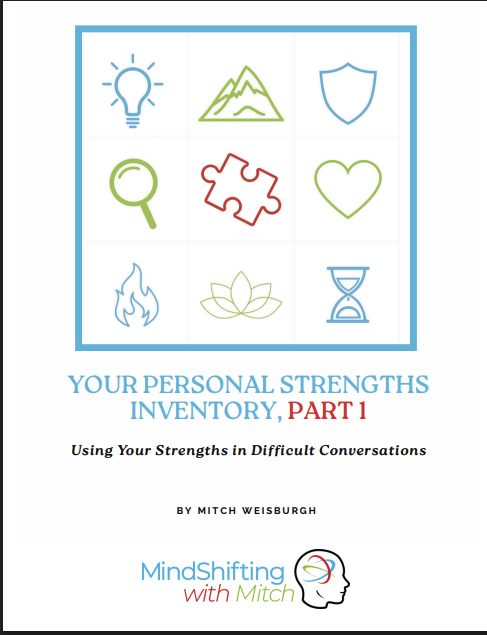
PART 1 - Using Your Strengths in Difficult Conversations
Know what you bring — and use it on purpose.
When a conversation gets tense, most of us fall back on our most reactive habits.
Part 1 is an instrument that helps you interrupt that pattern before it starts. It allows you to assess your character strengths, relationship strengths, cognitive strengths, and interpersonal strengths, and shows you how to best use them in conversations with others.
Crucially, it provides a built-in reflection process so you can refine your assessment and the way you use your own tools based on the actual conversations you have.
WHAT'S INSIDE
28 strengths across 4 categories: Character, Relationship, Thinking, Collaboration
Step 1 — Identify: Check off your top 5–7 natural strengths
Step 2 — Apply: Map your strengths to a specific upcoming conversation
Step 3 — Plan: Write how you'll use each strength + a self-talk statement
Step 4 — Reflect: Four reflection questions to use after the conversation
Teaser for the CASES method introduced in Part 2
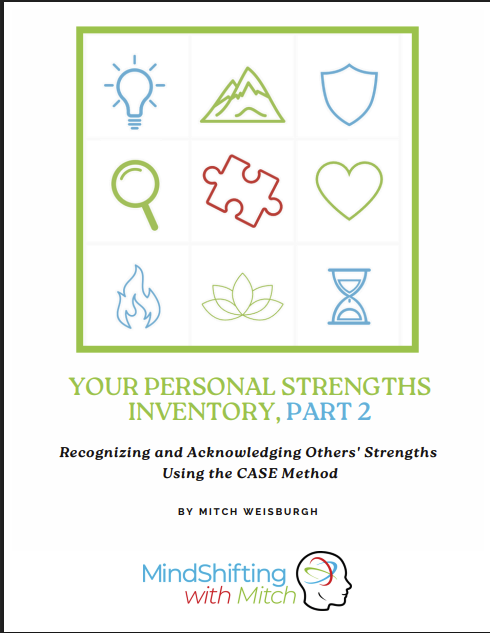
PART 2 — Recognizing and Acknowledging Others' Strengths (CASES Method)
Turn potential confrontations into strong connections.
Most feedback conversations fail before they start because they open with a criticism or judgment. The person you're talking with gets defensive, and the conversation either escalates or collapses.
Part 2 allows you to capitalize on the other person's strengths to prevent this.
When you acknowledge the strengths of another person, they feel heard, and they are much more likely to also listen to you. Developed by Finnish educators, the CASE Method is a five-step framework that changes the entire dynamic. Instead of fights where it is you criticizing them, it is you and them building each other up in order to solve a problem
WHAT'S INSIDE
The science: why criticism triggers defensiveness, and why acknowledgment bypasses it
The CASES Method — 5 steps: Context · Action · Strength · Effect · Step
Step-by-step practice worksheet for planning a CASES conversation
The 3:1 Rule and weekly practice — building a habit of genuine acknowledgment
Post-conversation reflection prompts