A MindShifting Book Study Group Guide
A 5-session deep dive into turning conflict into collaboration.
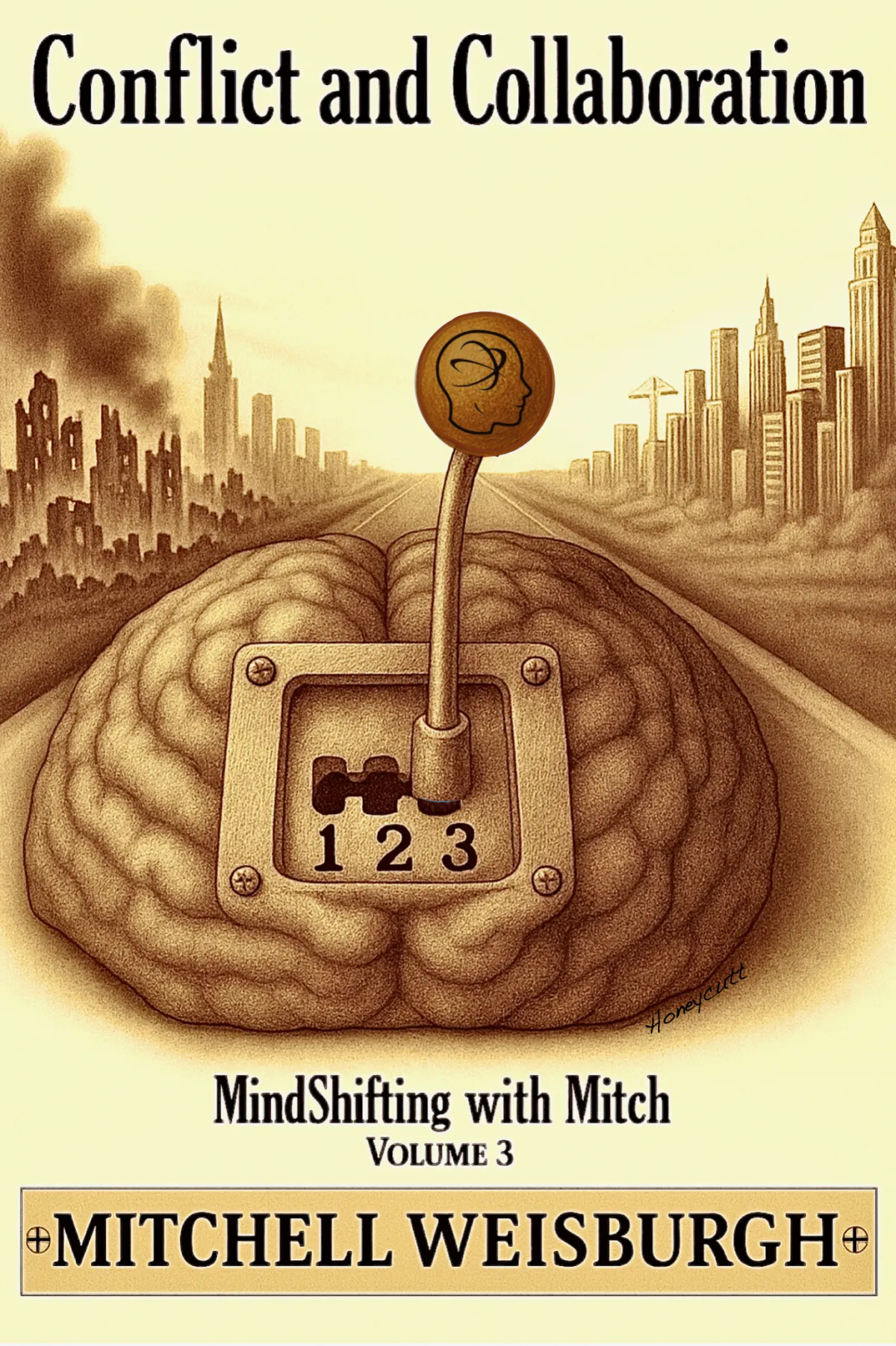
A free Leader Guide and participant handouts for MindShifting: Conflict and Collaboration — built for groups who want to learn the brain science, the techniques, and the practice — together, over time.
"Awareness creates choice, and choice creates change. The transformation doesn't require grand gestures. It starts here, in this room, and spreads from there."
— from the Conclusion
5 Sessions l ~90 mins each l Leader's Guide + Handouts
Get the Leader's Guide + handouts - FREE
(Fill this out to access the book club packet - instantly.)
By submitting this form, you agree to receive occasional emails from MindShifting with Mitch related to education, mindset, and professional development.
You can unsubscribe at any time by clicking the link in our emails and your information will never be shared or sold.
Two Documents. Five Sessions. Real practice/
The Leader Guide walks the facilitator through every session.
The Handouts go home with participants — including pre-session activities to make each meeting richer.
The Leader's Guide
20 pages - For The Facilitator
A facilitator's playbook for all five sessions. Chapter summaries, layered discussion questions, between-session practice..
A note from Mitch on what your job actually is
Suggested session structure & timing
Major-points summary for every session
Five-category discussion questions per session
Closing reflection & the Five Million Person Challenge
Participant Handouts
One Per Session
Print-and-pass-out summaries plus pre-session activities. Several sessions ask participants to come having tried something specific — the handouts make that clear and easy.
Major-points summary for each session's chapters
Pre-session activities (conflict styles assessment, NVC rewrites, AI experiments)
Between-session "what to try" practiceNotes space — designed to be written on
The Five Sessions
Each session pairs the right chapters together — biology first, then techniques, then how it scales to groups.
SESSION 1
Why Are So Many People Wrong?
Chapter 1
The foundational vocabulary: limbic vs. Sage.
The five limbic reactions (fight, flight, freeze, fluency, follow) and the five Sage powers (empathy, exploration, innovation, navigation, focused action).
The Interceptor and the OODA loop.
SESSION 2
Breaking the Win/Lose Cycle · The Five Styles
Chapters 2 + 3
Why the four default conflict strategies (incentives, scare tactics, trusted source, higher values) backfire. Mirror neurons. Rapport-building.
The five styles of conflict resolution from the Thomas-Kilmann model.
Pre-session: a free 10-minute conflict styles assessment.
SESSION 3
Resourceful Mindsets · Motivational Interviewing
Chapters 4 + 5
Pacing before leading. Constructive vs. destructive conflict.
An introduction to Motivational Interviewing — one of the most well-researched methods for influencing lasting behavior change.
Pre-session: draft an MI conversation, with or without an AI tool.
SESSION 4
Stress & Well-Being · Nonviolent Communication
Chapters 6 + 7
Eustress, distress, chronic stress — and why coregulation comes before collaboration.
The four-step NVC framework: observation, feeling, need, request.
Pre-session: rewrite judgmental statements as NVC observations using an AI tool, and notice what shifts.
SESSION 4
Groups & Group Pressure · The MindShift Beyond the Book
Chapter 8 + Conclusion
Collective illusions — everyone doing what nobody actually wants.
Acculturation creep, misreading the group, self-worth, the common enemy.
Closing with the Five Million Person Challenge: each participant names one specific commitment to carry forward.
How Sessions Are Structured
A repeatable, low-prep flow. About 90 minutes from check-in to commitment.
1. Quick
Check In
"What did you try since last time?" One sentence each. Grounds the group in real experience.
2. Major-points Summary
You read or paraphrase the summary.
Everyone's on the same page in five minutes.
3. Layered Discussion
Pick from five categories of prompts. Skip what doesn't fit. Stay where the heat is.
4. Try-it-this-week
One specific practice each person commits to before the next meeting.
5. Next Week's Handout
Pass out the next session's handout so participants can prep.
What Makes This Process Different
Five sessions, deliberately paced.
Each session pairs related chapters. Session 1 alone for the vocabulary, then 2+3, 4+5, 6+7, and 8+Conclusion. Built so theory and practice land together.
Practice between every session.
Pre-session activities, conflict styles assessments, AI experiments, NVC rewrites. People show up with material to discuss, not just chapters to recall.
Real techniques, not just concepts.
Motivational Interviewing and Nonviolent Communication are both rigorously researched methods. The packet teaches both, then has the group try them.
Scales from cohort to community.
Use it as a peer learning circle, a workplace L&D arc, a faith group's discussion series, or a civic organization's training around real local tensions.
FAQs
Do participants need to read Volume 1 before this?
No. Volume 3 stands alone, and the Leader Guide builds the brain-science vocabulary fresh in Session 1. If your group ends up curious about the inner work in Volume 1, that packet is right there.
How long is each session?
About 90 minutes. The Leader Guide includes more questions than you'll need; the goal is to leave room to follow the conversation where the heat is.
Do we have to use the AI exercises?
No. They're optional, designed for groups that have access to AI tools and want to use them as a learning aid. The full discussion works without them — the AI activities just give participants concrete drafts to compare and critique.
What's the pre-session conflict styles assessment?
A free 10-minute online assessment from the University of North Florida that maps participants to the five Thomas-Kilmann conflict styles. Session 2 is much richer when everyone arrives with their results.
Can I run this with a workplace team?
Yes — for internal team development, the packet is yours to use. If you're delivering it as part of paid coaching, training, or consulting, get in touch with Mitch first.. Both PDFs (Leader Guide + Handouts), no payment required. We ask for your name and email so we can send them and so Mitch can occasionally share new resources.
Is the full packet really free?
Yes. Both PDFs (Leader Guide + Handouts), no payment, no surprise membership. We ask for your name and email so we can send them and so Mitch can occasionally share new resources.