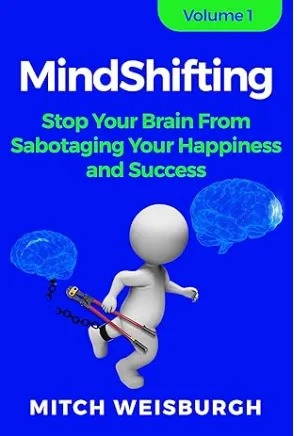
A MindShifting Practice Lab Guide for Volume 1
A 4-session deep dive into how to stop sabotaging yourself.
A free Leader Guide and participant handouts for MindShifting: Stop Your Brain From Sabotaging Your Happiness and Success — built for groups going further than one meeting can carry.
"What's one recurring fight, flight, freeze, habit, or mimic reaction that feels automatic in your life — and how might pausing for even a few seconds change how you respond?"
Section I: Reacting
4 Sessions l ~90 mins each l Leader's Guide + Handouts
Get the Leader's Guide + handouts - FREE
(Fill this out to access the book club packet - instantly.)
By submitting this form, you agree to receive occasional emails from MindShifting with Mitch related to education, mindset, and professional development.
You can unsubscribe at any time by clicking the link in our emails and your information will never be shared or sold.
Two Documents. Everything You Need.
Designed so the leader doesn't have to teach — only host. And the participants leave each session with something to actually try.
The Leader's Guide
20 pages - For The Facilitator
A facilitator's playbook with chapter summaries, layered discussion questions, and closing prompts for each of the four sessions. You don't have to be a coach.
A note from Mitch on what your job actually is
Suggested session structure & timing
Major-points summary for every session
Discussion questions in five categories: about the chapter, recognizing patterns, techniques to try, applying with others, applying to society
Closing reflection & between-session practice
Participant Handouts
One Page Per Chapter
Print-and-pass-out summaries each participant takes with them. Each handout captures the major points and the "what to try" between sessions, with space for notes.
A summary of the chapter
The week's between-session practice ("what to try")
Notes space — designed to be written on
The Four Sessions
Each session is built around one or two related chapters
SESSION 1
A Smarter
Way To React
Chapter 1
The simplified model of how the brain makes decisions: heuristic, emotional, and analytical. Sage vs. limbic.
Why certainty closes us off — and why metacognition (and "perhaps I can") starts to crack it open.
SESSION 2
Breaking Free From Our Scripts - Silencing Our Inner Critic
Chapters 2 + 3
How the brain builds scripts and stories as shortcuts. Part X and Saboteurs.
Apophenia.
The three-step process for changing stories: be aware, calm the emotion, change the story — plus practical tools from page 64 and the emotional cookie jar.
SESSION 3
Mastering Our Mind - Unleashing Our Own Brillance
Chapters 4 + 5
Cognitive dissonance, the Interceptor, the Self-Commander, and the flow quadrant.
The five Sage powers — empathy, exploration, innovation, navigation, focused action — and how each can be twisted into a fear-based version when the Saboteurs take over.
SESSION 4
The Realist's Guide To Happiness - The MindShift Beyond The Book
Chapter 6 + Conclusion
The Sage perspective: accept or convert. The three gifts (learning, practice, intention). The 80/20 rule of what actually matters.
Recognition hints for eight Saboteur types. Closing with one specific commitment each participant carries forward.
How Sessions Are Structured
Not a book report. Not a workshop curriculum. Something in between, on purpose.
1. Quick
Check In
"What did you try since last time?" One sentence each. Grounds the group in real experience.
2. Major-points Summary
You read or paraphrase the summary.
Everyone's on the same page in five minutes.
3. Layered Discussion
Pick from five categories of prompts. Skip what doesn't fit. Stay where the heat is.
4. Try-it-this-week
One specific practice each person commits to before the next meeting.
5. Next Week's Handout
Pass out the next session's handout so participants can prep.
What Makes This Process Different
It treats practice as the point.
Every session ends with a small, specific thing to try before the next meeting. The discussion in Session 2 isn't about Session 1's content — it's about what people noticed when they went looking.
It assumes you're not a coach.
The Leader Guide says it directly: your job isn't to teach. It's to create space. Anyone can run this. You don't need a credential.
It's layered, not scripted.
Five categories of prompts per session — about the chapter, recognizing patterns, techniques to try, applying with others, applying to society. Pick the layer your group needs that night.
It scales from book club to workplace.
The exact same packet works for a Sunday afternoon group of friends or a weekly L&D circle at work. The questions land in either context.
"Your job as leader isn't to teach the material. It's to create space for participants to connect it to their own lives — and to practice thinking out loud with people working on the same things."
— from the Leader Guide
FAQs
Do participants need to read the whole book before Session 1?
No. The structure is designed for participants to read 1–2 chapters between sessions, paced with the discussions. Session 1 covers Chapter 1 only.
How long is each session?
About 90 minutes. The Leader Guide includes more questions than you'll need; the goal is to leave room to follow the conversation where it wants to go.
Do I really not need facilitation experience?
Really. The Leader Guide is structured around your role being to host, not to teach. Mitch wrote a "Note to the Leader" specifically to make this point.
Can I print the handouts?
Yes. They're designed to be printed and passed out at the start of each session. They include space for notes.
Can I run this with a workplace team?
Yes — for internal team development, the packet is yours to use. If you're delivering it as part of paid coaching or consulting, get in touch with Mitch first.
Is the full packet really free?
Yes. Both PDFs (Leader Guide + Handouts), no payment required. We ask for your name and email so we can send them and so Mitch can occasionally share new resources.