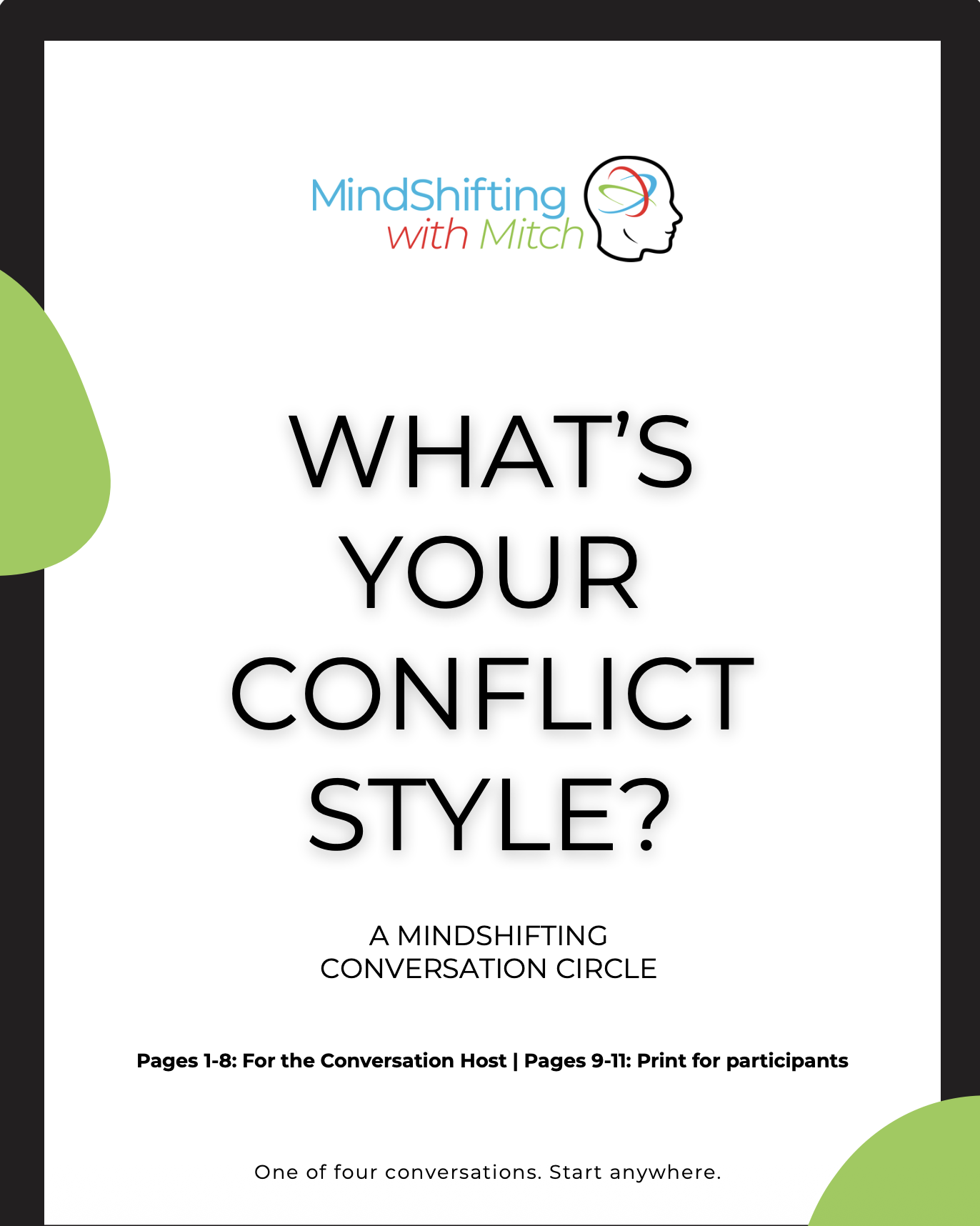
What You Get With This Free Conversation Circle Packet:
What's Your Conflict Style?:
A MindShifting Conversation Circle for Your Educator Team
Help your staff notice how they show up in conflict—and experiment with new ways to respond that serve students, families, and colleagues better.
In schools, conflict is everywhere: with students, families, colleagues, and even within leadership teams. Most of us rely on the same conflict moves over and over—pushing to win, backing down, avoiding, splitting the difference—without realizing the long‑term impact on trust and collaboration.
This Conversation Circle gives your educators a safe, structured space to name their default styles and explore what those patterns are costing them.
You don’t need a conflict‑resolution expert or a new initiative to launch. Everything is built for a non‑expert host: a playbook, icebreakers, a guided conversation arc with questions and timing, troubleshooting tips, and a closing script.
Your role is not to teach; it’s to host an honest conversation about how people handle disagreement and what could change.
A complete host playbook with timing, questions, and prompts for a 45–60 minute session you can run in a staff meeting, PLC, or PD block.
Ready‑to‑print participant handouts that explain the five conflict styles in plain language, with everyday school‑relevant examples.Three flexible icebreakers that help staff talk about real conflict moments without turning the session into therapy.
A guided conversation arc that moves from recognizing default styles, to understanding costs and benefits, to trying new approaches in real situations.
A closing script and takeaway sheet so educators leave with concrete things to notice and experiment with in their next difficult conversation.
Why This Conversation Matters To Your School/District
In most schools, people rarely have a chance to talk openly about how they handle conflict. They just keep doing what has “worked well enough”—competing, accommodating, avoiding—while tensions build under the surface. This Circle gives staff shared language for their default conflict styles and a structured space to explore what those habits protect, and what they quietly erode over time.
By naming the five styles—Compete, Avoid, Accommodate, Compromise, and Collaborate—educators can begin to match their approach to the situation instead of running on autopilot. They see that no style is inherently good or bad; each comes with upsides and costs, and the real power is in choosing rather than reacting.
For leaders, this becomes a practical way to strengthen culture: teams start to recognize when old patterns are getting in the way of problem‑solving, and they have a common framework for shifting into more collaborative conversations about students, families, and colleagues.
Get the Conflict Style Conversation Circle Packet
(Fill this out to access the full session guide and participant materials instantly.)
By submitting this form, you agree to receive occasional emails from MindShifting with Mitch related to education, mindset, and professional development.
You can unsubscribe at any time by clicking the link in our emails and your information will never be shared or sold.
This packet is designed for leaders who want to:
Give staff a structured way to talk about real conflict moments without blaming or shaming.
Build a shared, nonjudgmental language for the five conflict styles—and when each one helps or hurts.
Run a meaningful session without spending hours designing new PD content.
You can host this Conversation Circle in a staff meeting, PD day, department meeting, or with a leadership team. No lectures or slide decks required—just people talking honestly about how they handle conflict now and what they might want to try differently.