Submitted For Your Book Club Consideration...
Awareness creates choice. Choice changes everything.
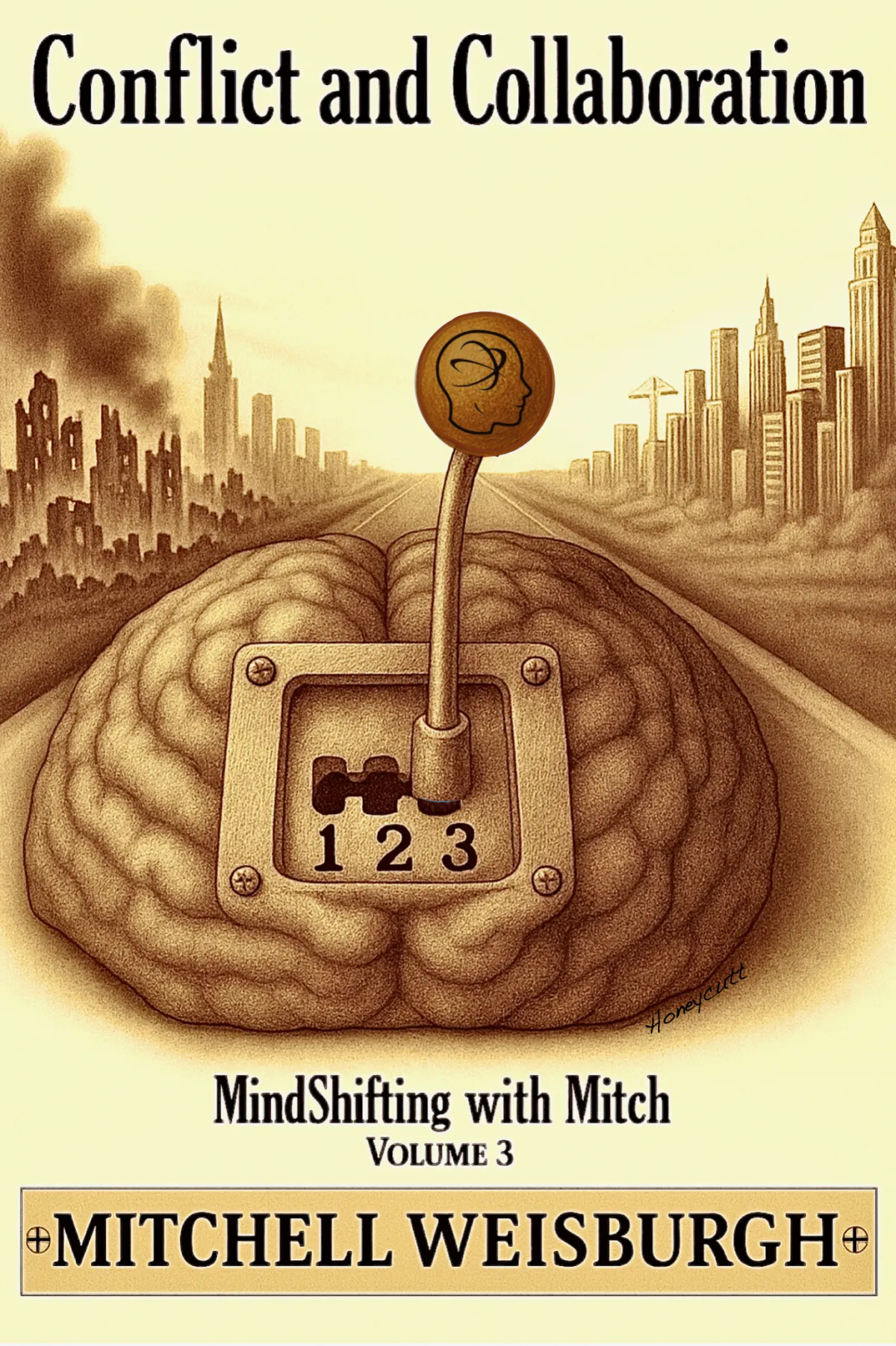
A free, single-meeting discussion guide for MindShifting: Conflict and Collaboration — the kind of conversation that turns a divided room (or family, or team) into one that's actually listening.
"When do you notice the 'need to be right' showing up most strongly — and what suggestions do you have for working around it?"
— Section I: Understanding Conflict
90-minute meeting l 7 prompts
3 real-life scenarios
Get the packet - FREE
(Fill this out to access the book club packet - instantly.)
By submitting this form, you agree to receive occasional emails from MindShifting with Mitch related to education, mindset, and professional development.
You can unsubscribe at any time by clicking the link in our emails and your information will never be shared or sold.
What's the book about?
Conflict feels personal because our minds are wired for certainty and our identities are wrapped up in our beliefs. Through the lens of neuroscience, the book shows how the limbic system reacts to threat — and how awareness of that reactivity opens the door to empathy and reason.
Volume 3 introduces the practical tools of MindShifting in relationships: noticing emotional triggers, reframing our stories, and choosing curiosity instead of defense. Techniques like Motivational Interviewing and Nonviolent Communication show how to listen and speak in ways that reduce resistance and increase understanding. The book closes with a call to action — the Five Million Person Challenge — an invitation to spread collaborative thinking through conscious conversation.
Conflict is unavoidable. Collaboration is a choice.
What's In The Packet?
A welcome from Mitch: A short, warm note from the author setting the tone for the conversation.
An overview of the book: A two-paragraph plain-English summary you can read aloud to ground the room.
Seven discussion prompts: Designed to move from understanding conflict to extending collaboration.
A closing reflection: Three questions to help everyone leave with one specific intention for the coming week.
How to host this discussion: Set the tone, follow the flow, share the floor, end with reflection.
Three themed sections of prompts: Understanding Conflict · Transforming Conversations · Extending Collaboration. — each anchored in the book's chapters and key ideas.
Three integrated scenarios: Workplace tension, family dispute over an aging parent, and a divided community committee — built to ground theory in life.
The Three Sections of the Discussion
SECTION 1
Understanding Conflict
Chapters 1 –3: Why Are So Many People Wrong? · Breaking the Win/Lose Cycle · The Five Styles
Why our brains are built to protect beliefs rather than question them — and how confirmation bias keeps us locked into our "rightness..
SECTION 2
Transforming Conversations
Chapters 4–7: Resourceful Mindsets · Motivational Interviewing · Stress & Conflict · Non-Violent Communication
How to shift from reactive to resourceful — using mindfulness, MI to guide with empathy, and NVC to express needs without judgment.
SECTION 3
Extending Collaboration
Chapter 8 & Conclusion: Group Pressure · The MindShift Beyond the Book
Group pressure shapes behavior more than we realize — and collaboration scales one conversation, one community at a time.
Who This Packet Is For:
Book clubs choosing a meatier read
Groups that want a discussion with stakes — about how we work, parent, vote, and disagree.
Community circles & civic groups
Neighborhood associations, faith groups, and civic organizations using the packet to navigate real local tensions.
Anyone tired of 'winning' conversations
You've noticed the tax that being right keeps charging you. You're ready to try something else.
FAQs
Do we need to have read Volume 1 first?
Yes. The packet assumes everyone has read Volume 1. The whole point is to discuss what landed, what didn't, and where the ideas show up in your real life.
How long does the meeting take?
Most groups land at 90 minutes. The guide is designed to flex from one hour (skip a few prompts) to two hours (use all the prompts plus all three scenarios).
Will this turn our book club into a therapy session?
No. The prompts are designed to keep things curious and reflective without pushing anyone to open up beyond their comfort. As Mitch says: there's no test, and definitely no group hug requirement.
Is the packet really free?
Yes — completely. We ask for your name and email so we can send the PDF, and so Mitch can occasionally share new resources or notes if you'd like.